
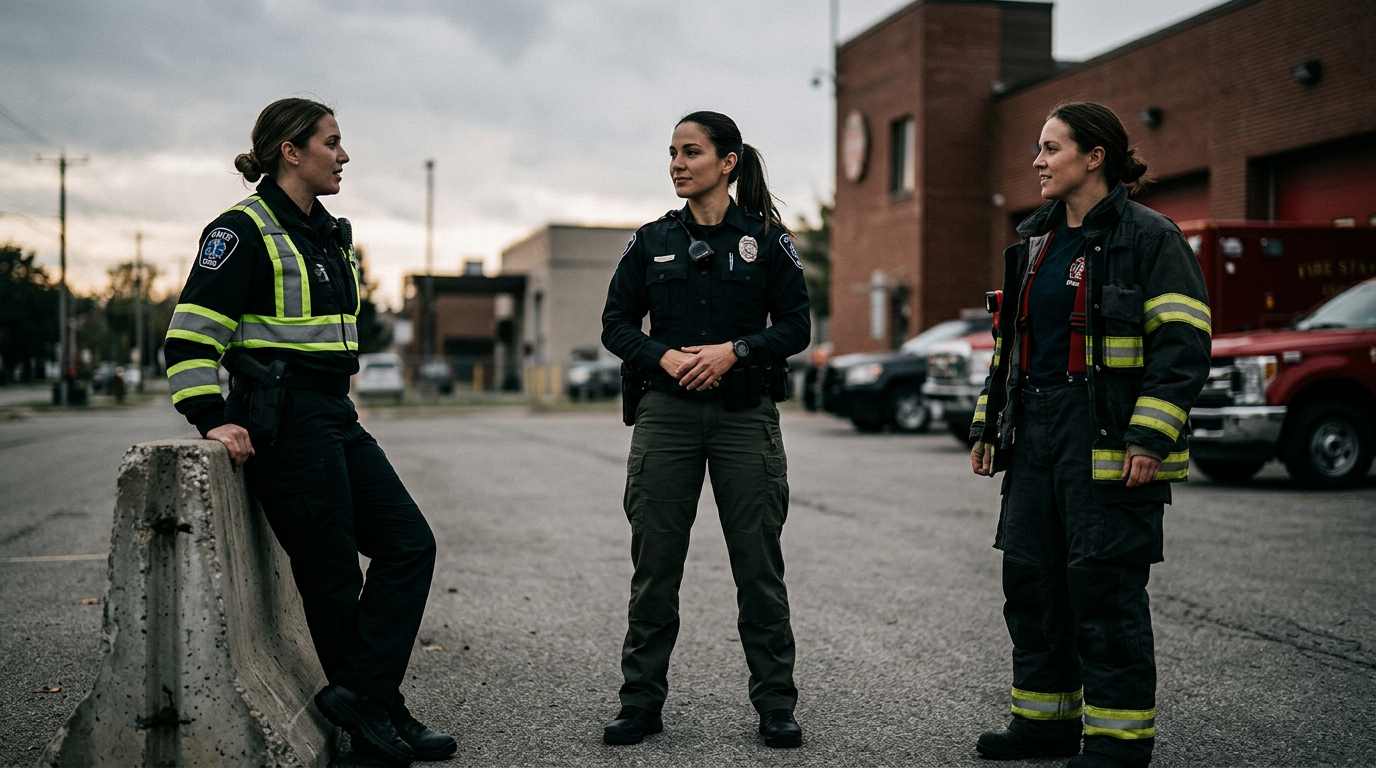
You know what's funny?
Ask ten women in uniform how they feel about shopping for work pants.
You'll probably get ten eye rolls.
Not because we don't like new gear.
Because we already know how it ends.
One pair won't make it past your thighs.
The next fits your legs but leaves a gap at the waist big enough to lose your radio.
Another feels okay…
…until you sit down.
Or climb into the truck.
Or kneel beside a patient.
Or hop a fence.
Or spend two hours in a patrol car.
Then you're tugging at your waistband.
Again.
By the end of the shift you've adjusted your pants so many times you don't even notice you're doing it anymore.
Somehow, we've all been convinced that's normal.
We don't think it is.
We've Been Asking the Wrong Question
For years, the conversation has been:
"What size do I need?"
Maybe that's the wrong question.
Maybe the better question is:
"Why doesn't this pattern fit women like me?"
Because if you've ever thought…
"If they fit my hips, the waist is too big."
"If they fit my waist, I can't squat."
"I have to buy men's pants because they're the only ones that fit my legs."
…you're definitely not the only one.
Honestly?
Those are some of the most common things we've heard from women.
Firefighters.
Police officers.
EMTs.
Park rangers.
Corrections officers.
Women who spend all day moving.
Women who don't have time to think about their clothes because they're too busy doing their jobs.
The Problem Probably Isn't Your Body
Let's get one thing out of the way.
Your body isn't "hard to fit."
We hate hearing women say that.
Because it usually comes after years of trying on pants that clearly weren't made for them.
Think about the women who wear tactical pants every day.
They climb stairs carrying equipment.
They kneel.
They crawl.
They drag hose.
They lift patients.
They hike trails.
They strength train because their job demands it.
Of course their bodies look different.
Why wouldn't they?
Strong thighs aren't a problem.
Strong glutes aren't a problem.
Having hips isn't a problem.
The problem is expecting one pattern to fit every woman who wears it.
"Just Size Up."
If you've ever been told that, we'd guess it didn't solve much.
Sure.
Sizing up might give you a little more room in your thighs.
It might even feel better—for about five minutes.
Then the waistband starts sliding.
You tighten your belt.
Now the waistband digs into your stomach.
The extra fabric bunches in the front.
You're constantly pulling your pants back into place.
You solved one problem.
You created three more.
That's not good design.
That's a compromise.
And women have been asked to make that compromise for a long time.
Here's Something We Learned
When we first started studying women's workwear, we assumed stretch fabric was the answer.
If the pants stretch more…
…they'll fit more women.
Right?
Not exactly.
Stretch helps.
Good fabric matters.
But we've learned something that surprised us.
A great fabric can't fix a bad pattern.
If the waistband sits in the wrong place…
If the rise isn't balanced…
If the hips don't have enough shape…
If the thighs don't have enough room…
No amount of stretch is going to make those pants feel right.
That's why two pairs of pants made from almost the same fabric can feel completely different.
One moves with you.
The other fights you all day.
So What Should Tactical Pants Actually Feel Like?
Here's our test.
If your pants fit correctly…
You shouldn't think about them.
You shouldn't have to pull them up every time you stand.
You shouldn't loosen your belt after lunch.
You shouldn't avoid squatting because you already know what's going to happen.
Good workwear disappears.
It lets you focus on your job instead of your clothes.
That sounds simple.
It should be.
This Is Just the Beginning
Over the next few weeks, we're going to dig into every part of women's tactical fit.
Why waistbands gap.
Why pants bunch in the front.
What "rise" actually means.
Why some pockets are useful, and others just get in the way.
Why stretch isn't the same thing as mobility.
And why so many women have spent years believing their bodies were the problem.
We don't think they ever were.
We think the industry just got comfortable asking women to adapt.
We're more interested in asking a different question.
What if the clothing adapted to the women instead?

Leave a comment
This site is protected by hCaptcha and the hCaptcha Privacy Policy and Terms of Service apply.